PET bottles are widely used in the beverage, food, pharmaceutical, personal care, and household chemical industries. From drinking water and carbonated beverages to cooking oil and cosmetic products, PET packaging has become an important part of modern manufacturing due to its lightweight structure, transparency, strength, and versatility.
But how are these bottles actually manufactured?
The PET bottle blow molding process is a manufacturing method that transforms PET preforms into finished bottles through controlled heating, stretching, and compressed air expansion inside a mold. The process is commonly known as stretch blow molding, in which the material is stretched both longitudinally and radially to achieve the required bottle shape and mechanical properties.
Understanding this process is essential for manufacturers who want to improve production efficiency, maintain consistent bottle quality, reduce material waste, and select the right PET bottle production equipment.
In this guide, we will explain each stage of PET bottle manufacturing, from preform preparation and heating to stretch blowing, cooling, and final quality inspection. We will also compare semi-automatic and fully automatic production systems and discuss the auxiliary equipment required for an efficient PET bottle production line.
1. What Is a PET Preform?
Before understanding the PET bottle blow molding process, it is important to understand the role of the PET preform.
A PET preform is a semi-finished plastic component manufactured through injection molding. It resembles a small test tube, with a finished threaded neck and a thicker body that will later be transformed into a complete bottle.
Unlike extrusion blow molding, where molten plastic is extruded directly into a parison, PET stretch blow molding typically starts with an injection-molded preform.
How Is a PET Preform Manufactured?
The production of PET preforms generally involves the following stages:
- PET resin pellets are dried to remove moisture before processing.
- The dried PET material is melted inside an injection molding machine.
- Molten PET is injected into a preform mold under controlled pressure.
- The material is cooled and solidified into the required preform shape.
- The finished preforms are removed and prepared for subsequent bottle production.
The preform already contains the final bottle neck and thread dimensions. During the subsequent blow molding process, its body is heated, stretched, and expanded to form the bottle.
Why Is Preform Quality Important?
The quality of a PET preform directly influences the final bottle’s appearance, mechanical strength, and dimensional consistency.
Important preform characteristics include:
- Material quality: The PET resin must meet the requirements of the intended packaging application.
- Moisture content: Excessive moisture during melting can cause hydrolytic degradation and reduce the molecular weight of PET.
- Wall thickness distribution: Consistent preform dimensions help achieve more predictable material distribution during stretching.
- Neck finish accuracy: The threaded neck must maintain its dimensions to ensure compatibility with caps and closures.
- Preform weight: The amount of PET material affects bottle weight, wall thickness, and overall packaging performance.
A well-designed preform provides a stable starting point for the entire PET bottle manufacturing process.
2. How Does the PET Bottle Blow Molding Process Work?
The PET bottle blow molding process uses heat, mechanical stretching, and compressed air to transform a preform into a finished bottle.
The most common industrial method is two-stage injection stretch blow molding (ISBM), in which preforms are manufactured separately and subsequently reheated and blown into bottles.
The typical production process consists of the following stages:
Step 1: Preform Loading
PET preforms are loaded into the feeding system of the PET bottle blowing machine.
In an automatic production line, a preform feeding and orientation system arranges the preforms and transfers them into the heating section.
For semi-automatic machines, operators typically load the preforms manually or use a simpler feeding arrangement.
Step 2: Preform Heating
The preforms pass through an infrared heating system that raises the temperature of the PET material to a suitable condition for stretching and blowing.
Heating must be carefully controlled to achieve the required temperature distribution throughout the preform body.
Step 3: Preform Transfer and Mold Closing
After heating, the preform is transferred to the blowing station.
The mold closes around the preform, securing it in the correct position for the forming process.
The preform neck is generally held in position while its heated body is prepared for stretching and expansion.
Step 4: Stretching and Pre-Blowing
A mechanical stretch rod moves downward through the preform, stretching the heated PET material along its longitudinal axis.
At the same time, compressed air is introduced to initiate radial expansion.
Pre-blowing helps control how the material expands inside the mold and influences the distribution of PET along the bottle body.
Step 5: High-Pressure Blowing
High-pressure compressed air is introduced to expand the stretched PET material against the internal surface of the mold cavity.
The PET takes the shape of the mold, forming the bottle body, shoulders, base, and other designed features.
Step 6: Cooling and Solidification
The PET material cools while in contact with the mold.
Cooling allows the bottle to retain its designed shape and dimensions after the forming pressure is released.
The cooling system and mold temperature conditions play important roles in maintaining production stability.
Step 7: Mold Opening and Bottle Removal
After the forming and cooling stages are completed, the mold opens and the finished bottle is removed.
In an automatic PET bottle production line, the bottles are transferred to downstream handling, inspection, and packaging equipment.
Step 8: Quality Inspection
The finished bottles are checked for dimensional accuracy, visual appearance, wall thickness distribution, leakage, and other application-specific requirements.
Depending on the production line, inspection may be performed manually, automatically, or through a combination of both methods.
PET Bottle Blow Molding Process Flow:
Preform Loading → Infrared Heating → Transfer → Mold Closing → Stretching → Pre-Blowing → High-Pressure Blowing → Cooling → Mold Opening → Bottle Removal → Quality Inspection
Each stage contributes to the final bottle quality. Stable production therefore depends not only on the blow molding machine itself but also on preform quality, heating conditions, blowing parameters, and mold design.
3. PET Preform Heating: Why Is Temperature Control Important?
Preform heating is one of the most critical stages in PET stretch blow molding.
Unlike conventional extrusion blow molding, PET stretch blow molding requires the preform to reach a suitable temperature range before it can be stretched and expanded.
If the material is too cold, it may not stretch properly. If it is overheated, the preform may lose dimensional stability or develop unwanted deformation.
How Does Infrared Heating Work?
Most industrial PET bottle blowing machines use infrared heating systems.
During this process, preforms rotate or move through a heating tunnel equipped with infrared lamps. The infrared radiation heats the PET material, preparing it for the subsequent stretching and blowing stages.
The heating system generally includes:
- Infrared heating lamps
- Reflectors and heating shields
- Preform rotation mechanisms
- Cooling fans
- Temperature adjustment controls
The heating arrangement can be adjusted according to preform dimensions, weight, material characteristics, and bottle design.
Why Is Uniform Heating Important?
Uniform heating is essential because PET must stretch in a controlled manner during the blowing process.
Poor temperature distribution can lead to uneven material deformation and inconsistent bottle wall thickness.
For example:
- Excessive heating in one area may cause localized thinning or deformation.
- Insufficient heating may prevent the PET from stretching properly.
- Uneven heating between the preform body and base can affect material distribution in the finished bottle.
- Inconsistent heating between production cycles can cause variations in bottle dimensions and appearance.
Factors Affecting PET Preform Heating
Several factors influence the heating process:
- Preform weight and dimensions: Heavier or thicker preforms generally require different heating conditions.
- Infrared lamp power: Heating intensity must be adjusted to suit the material and production requirements.
- Heating time: The time spent in the heating tunnel affects the temperature reached by the preform.
- Preform rotation: Rotation helps improve circumferential heating uniformity.
- Cooling and ventilation: Air circulation helps regulate the temperature distribution and prevent excessive surface heating.
The objective is not simply to heat the entire preform to the highest possible temperature. It is to establish a controlled temperature profile that allows the PET material to stretch uniformly and form a bottle with the required properties.
4. The PET Stretch Blow Molding Process Explained
The core of PET bottle manufacturing is stretch blow molding.
This process combines mechanical stretching and pneumatic expansion to transform a heated preform into a finished bottle.
What Is Biaxial Orientation?
One of the most important characteristics of PET stretch blow molding is biaxial orientation.
Biaxial orientation occurs when PET material is stretched in two directions:
- Axial stretching: The material is stretched along the longitudinal direction of the bottle using a mechanical stretch rod.
- Radial stretching: The material expands outward through compressed air until it reaches the mold walls.
The combination of these two stretching directions changes the molecular orientation of PET and contributes to the mechanical properties of the finished bottle.
Depending on the processing conditions, biaxial orientation can improve:
- Tensile strength
- Impact performance
- Transparency
- Dimensional stability
- Resistance to internal pressure
These characteristics make PET stretch blow molding particularly suitable for beverage packaging, including carbonated drink bottles that must withstand internal pressure.
What Is the Difference Between Pre-Blowing and High-Pressure Blowing?
The blowing stage is commonly divided into two main operations.
Pre-Blowing
Pre-blowing introduces compressed air at an earlier stage while the stretch rod is extending the preform.
Its purpose is to initiate controlled radial expansion and help manage material distribution throughout the bottle.
The timing and pressure of pre-blowing are important because they influence how the PET material moves and stretches inside the mold.
High-Pressure Blowing
After the initial expansion, higher-pressure air is introduced to expand the PET material fully against the mold cavity.
This stage defines the final bottle geometry and helps reproduce the mold’s designed details.
The required pressure and timing depend on the machine design, preform characteristics, bottle size, and production conditions.
Why Do Stretching and Blowing Parameters Matter?
The interaction between stretch rod movement, pre-blowing timing, air pressure, and heating conditions determines how the PET material is distributed throughout the bottle.
If these parameters are not properly coordinated, manufacturers may encounter:
- Uneven bottle wall thickness
- Poor base formation
- Incomplete mold reproduction
- Excessive material accumulation in certain areas
- Inconsistent bottle dimensions
For this reason, optimizing the PET stretch blow molding process requires a coordinated approach rather than adjusting a single parameter independently.
5. Semi-Automatic vs. Fully Automatic PET Bottle Production
PET bottle manufacturing equipment is available in different automation configurations.
Two common options are semi-automatic and fully automatic PET bottle blowing machines.
The right choice depends on production volume, labor availability, factory layout, investment budget, and the level of automation required.
Semi-Automatic PET Bottle Blowing Machine
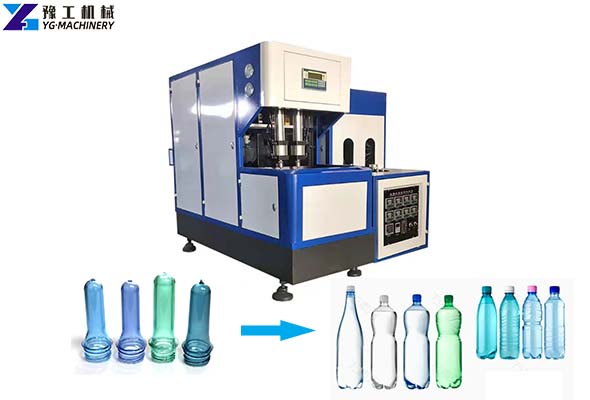
A semi-automatic PET bottle blowing machine typically requires manual preform loading or transfer between certain production stages.
The heating, stretching, blowing, and forming operations are performed by the machine according to its design and operating controls.
Main characteristics:
- Lower initial equipment investment in many configurations.
- More manual involvement in preform handling.
- Suitable for smaller production operations and flexible manufacturing requirements.
- May require more operator attention during production.
- Production capacity is generally lower than comparable fully automatic systems.
Semi-automatic machines can be a practical option for small and medium-sized manufacturers, particularly when production requirements do not justify a highly automated line.
Fully Automatic PET Bottle Blowing Machine
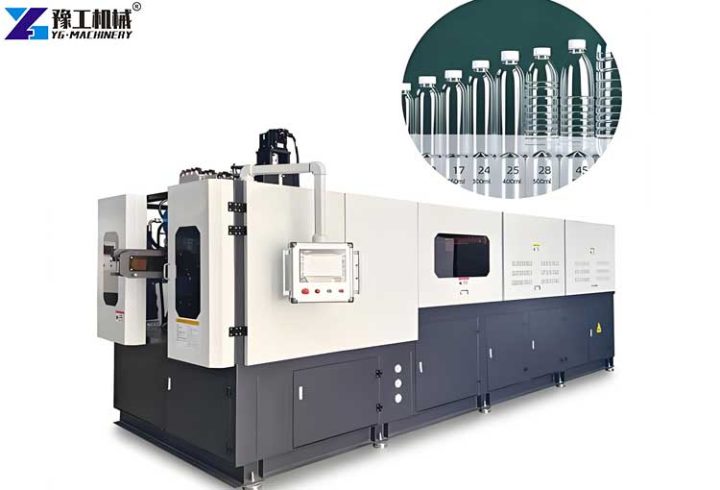
A fully automatic PET bottle blowing machine integrates preform feeding, heating, transfer, stretch blowing, and bottle discharge into a coordinated production system.
The equipment automatically transfers preforms through the production stages, reducing manual handling and supporting continuous operation.
Main characteristics:
- Automatic preform feeding and handling.
- Integrated heating and stretch blow molding operations.
- Higher potential production capacity.
- Reduced manual intervention.
- More consistent production when operating conditions are properly controlled.
- Suitable for medium- and large-scale manufacturing.
Fully automatic equipment is particularly useful for manufacturers producing large quantities of bottles with consistent specifications.
Comparison: Semi-Automatic vs. Fully Automatic PET Blow Molding
| Comparison | Semi-Automatic Machine | Fully Automatic Machine |
|---|---|---|
| Preform Loading | Manual or partially automated | Automatic |
| Material Transfer | More manual involvement | Integrated automatic transfer |
| Production Capacity | Generally lower | Generally higher |
| Labor Requirements | Higher | Lower |
| Initial Investment | Generally lower | Generally higher |
| Production Flexibility | Suitable for smaller batches | Suitable for continuous production |
| Typical Applications | Small and medium-scale operations | Medium- and large-scale production |
It is important to note that actual output depends on bottle volume, number of cavities, machine configuration, cycle time, and operating conditions. Automation level alone does not determine production capacity.
Which Type Should You Choose?
A semi-automatic PET bottle blowing machine may be appropriate if you:
- Have relatively low or variable production requirements.
- Want to reduce initial equipment investment.
- Have sufficient labor available for manual handling.
- Need flexibility for smaller production operations.
A fully automatic PET bottle blowing machine may be more suitable if you:
- Require higher production output.
- Manufacture bottles continuously.
- Want to reduce manual handling.
- Need an integrated production line.
- Have established demand for standardized bottle products.
The most appropriate configuration should be selected according to the actual production plan rather than simply choosing the machine with the highest automation level.
6. How to Control PET Bottle Quality During Production
Producing PET bottles with consistent quality requires control over every major stage of the manufacturing process.
Even when using high-quality PET resin and advanced equipment, poor process settings can result in defective bottles.
The following factors are particularly important.
1. Preform Quality Control
The preform determines the initial material distribution and provides the foundation for bottle formation.
Manufacturers should check:
- Preform weight and dimensional consistency.
- Neck finish and thread accuracy.
- Material transparency and appearance.
- Moisture-related degradation risks.
- Surface defects and contamination.
Using preforms with consistent specifications helps reduce variations during blow molding.
2. Heating Temperature Control
Temperature distribution directly affects PET stretching behavior.
Insufficient heating may result in poor stretching and incomplete mold reproduction, while excessive or uneven heating can cause deformation and inconsistent wall thickness.
Manufacturers should optimize:
- Infrared heating intensity.
- Heating time.
- Preform rotation.
- Cooling fan settings.
- Temperature distribution along the preform body.
3. Stretching and Blowing Parameter Control
The stretch rod position, movement speed, pre-blowing timing, and high-pressure blowing conditions must be coordinated.
These parameters influence the expansion sequence and the distribution of material throughout the bottle.
Stable operating conditions help maintain consistent bottle geometry and mechanical performance.
4. Mold Design and Temperature Control
The mold determines the final shape and surface details of the bottle.
Its design should account for:
- Bottle dimensions and geometry.
- Material distribution requirements.
- Cooling channel arrangement.
- Neck and base design.
- Mold alignment and closing accuracy.
Effective mold cooling helps the bottle solidify consistently and maintain its shape after removal.
5. Wall Thickness Distribution
One of the most important quality indicators in PET bottle manufacturing is wall thickness distribution.
If the material is not distributed evenly during stretching and blowing, certain areas may become excessively thin while others contain unnecessary material.
This can affect:
- Mechanical strength.
- Resistance to internal pressure.
- Drop performance.
- Packaging stability.
- Material consumption.
Wall thickness should be evaluated at critical areas, including the shoulder, body, heel, and base.
6. Finished Bottle Inspection
A comprehensive quality inspection system may include:
| Quality Parameter | What to Check |
|---|---|
| Appearance | Transparency, surface defects, deformation |
| Dimensions | Bottle height, diameter, and shape |
| Wall Thickness | Material distribution across different sections |
| Weight | Consistency between production batches |
| Leakage | Integrity of the bottle structure |
| Top Load | Resistance to vertical compression |
| Burst Pressure | Resistance to internal pressure, where applicable |
| Drop Performance | Resistance to impact during handling |
Not every test is necessary for every bottle application. Testing requirements should reflect the intended use, applicable packaging standards, and customer specifications.
For example, carbonated beverage bottles require particular attention to internal pressure resistance, while water bottles may prioritize lightweight design, dimensional stability, and handling performance.
Effective quality control is therefore not simply about identifying defective products. It is about maintaining stable process conditions that prevent defects from occurring in the first place.
7. What Auxiliary Equipment Is Needed for PET Bottle Manufacturing?
A PET bottle production line involves more than the blow molding machine itself.
Depending on the production configuration, several auxiliary systems are required to ensure stable material handling, heating, compressed air supply, cooling, inspection, and packaging.
1. PET Preform Feeding System
The feeding system transfers preforms into the machine and ensures that they are correctly positioned before entering the heating section.
Automatic feeding systems help reduce manual handling and support continuous production.
2. Air Compressor System
Compressed air is essential for PET stretch blow molding.
The air supply system generally includes:
- High-pressure air compressors.
- Low-pressure air compressors, where required.
- Air storage tanks.
- Air filters and dryers.
- Pressure regulation and distribution systems.
The compressed air system must provide sufficient pressure, flow rate, and air quality to meet the requirements of the blow molding machine.
High-pressure air is particularly important during the final bottle expansion stage.
3. Industrial Chiller
The cooling system helps maintain suitable temperatures for the mold and other temperature-sensitive machine components.
A stable cooling water supply supports consistent production cycles and helps prevent excessive mold temperatures.
4. Water Treatment Equipment
Depending on the application and production setup, water treatment systems may be required to manage cooling water quality and reduce scaling or contamination in the cooling circuit.
5. Conveyor System
Conveyors transfer finished bottles from the blowing machine to downstream inspection, labeling, filling, or packaging equipment.
They help connect individual production stages into a more integrated manufacturing line.
6. Bottle Inspection Equipment
Automated inspection equipment can detect certain defects, including:
- Incorrect bottle dimensions.
- Deformation.
- Surface defects.
- Missing or damaged bottle features.
- Leakage, depending on the inspection technology.
The inspection system should be selected according to the required quality standards and production speed.
7. Labeling and Packaging Machines
After inspection, bottles may be transferred to labeling, filling, and packaging operations.
The exact equipment depends on whether the customer manufactures empty PET bottles for sale or operates an integrated bottle-filling and packaging facility.
Building a Complete PET Bottle Production Line
A typical PET bottle manufacturing setup may include:
PET Preform Supply → Preform Feeding → Infrared Heating → PET Blow Molding Machine → Bottle Discharge → Inspection → Conveying → Downstream Filling or Packaging
The required equipment configuration depends on production capacity, factory layout, bottle specifications, and the degree of automation.
When planning a PET bottle production line, manufacturers should evaluate the compatibility of all auxiliary systems rather than selecting each machine independently.
8. Common Problems in PET Bottle Blow Molding and How to Solve Them
Even well-designed PET bottle production lines can experience quality problems if the process is not properly controlled.
Understanding the relationship between common defects and their possible causes helps manufacturers improve production stability.
| Common Problem | Possible Causes | Recommended Checks |
|---|---|---|
| Uneven wall thickness | Incorrect heating profile or stretching conditions | Check preform heating and stretch rod settings |
| Cloudy or hazy bottle | Improper heating, material condition, or crystallization | Check preform quality and temperature profile |
| Incomplete bottle formation | Insufficient heating or blowing pressure | Check heating conditions and air supply |
| Deformed bottle | Inadequate cooling or premature handling | Check mold cooling and removal timing |
| Weak bottle base | Incorrect preform design or stretching and blowing sequence | Review base design and process parameters |
| Excessive material in certain areas | Poor material distribution during stretching | Optimize heating and stretching conditions |
| Inconsistent bottle dimensions | Unstable heating, mold alignment, or process settings | Check equipment stability and mold conditions |
These symptoms can have multiple causes, so troubleshooting should be based on systematic inspection rather than changing several machine settings at the same time.
A practical troubleshooting procedure is:
- Identify the defect and determine where it occurs.
- Check whether the problem affects all bottles or only certain cavities.
- Inspect the preform quality and dimensions.
- Review heating conditions and temperature distribution.
- Check stretch rod movement and blowing parameters.
- Inspect mold alignment and cooling conditions.
- Make controlled adjustments and verify the results.
A structured troubleshooting approach helps reduce unnecessary material waste and avoid repeated production interruptions.
9. How to Choose the Right PET Bottle Blowing Machine
Selecting the right PET bottle blowing machine is an important investment decision for manufacturers.
The best equipment is not necessarily the machine with the highest rated output or the lowest purchase price. It should match the actual bottle specifications, production targets, operating conditions, and long-term business requirements.
Here are the main factors to consider.
1. Bottle Capacity and Design
Start by identifying the products you intend to manufacture.
Important considerations include:
- Bottle volume.
- Bottle height and diameter.
- Neck finish specifications.
- Bottle shape and base design.
- Intended packaging application.
A machine designed for small water bottles may not be suitable for larger PET containers without the appropriate machine configuration and mold system.
2. Required Production Capacity
Estimate your actual production demand rather than relying only on the machine’s maximum advertised output.
Consider:
- Required bottles per hour.
- Number of cavities.
- Bottle volume and weight.
- Expected operating hours.
- Planned production shifts.
- Allowance for maintenance and downtime.
Production capacity should be evaluated using the actual bottle specification and the supplier’s confirmed machine configuration.
3. Semi-Automatic or Fully Automatic Configuration
Choose the automation level based on production volume, labor availability, and investment budget.
Smaller manufacturers may prefer semi-automatic equipment, while larger operations may benefit from fully automatic systems.
4. Energy and Compressed Air Consumption
PET bottle production involves several energy-consuming systems, including infrared heating, air compression, and cooling.
When comparing machines, evaluate:
- Electrical power consumption.
- High-pressure air requirements.
- Low-pressure air requirements, where applicable.
- Cooling water consumption.
- Energy efficiency under actual production conditions.
The compressed air system deserves particular attention because high-pressure air generation can represent a significant part of the operating energy demand.
5. Mold Quality and Compatibility
The mold directly determines the final bottle shape and dimensions.
Manufacturers should confirm:
- Mold material and construction.
- Number of cavities.
- Cooling system design.
- Bottle design compatibility.
- Mold replacement and maintenance requirements.
If you plan to manufacture several bottle designs, consider the ease and cost of changing molds.
6. Supplier Experience and Technical Support
A reliable machine supplier should provide more than equipment delivery.
Evaluate whether the manufacturer can offer:
- Technical consultation.
- Machine configuration recommendations.
- Customized bottle molds.
- Installation and commissioning support.
- Operator training.
- Spare parts and after-sales service.
These factors can significantly influence the long-term operating performance of a PET bottle production facility.
Before purchasing a machine, provide the supplier with your bottle drawings, preform specifications, target output, and production requirements. This allows the supplier to recommend a more appropriate machine configuration.
10. Frequently Asked Questions
Q1: What is the PET bottle blow molding process?
The PET bottle blow molding process is a manufacturing method that converts PET preforms into finished bottles through controlled heating, mechanical stretching, and compressed air expansion inside a mold.
It is commonly known as PET stretch blow molding.
Q2: What is the difference between PET injection molding and PET blow molding?
PET injection molding is used to manufacture preforms by injecting molten PET into an injection mold.
PET blow molding subsequently transforms these preforms into finished bottles through heating, stretching, and compressed air expansion.
Both processes are important in conventional two-stage PET bottle manufacturing.
Q3: Why do PET preforms need to be heated before blowing?
PET preforms need to be heated to a suitable temperature so that the material can stretch and expand during the forming process.
Proper heating helps achieve controlled material distribution, consistent bottle dimensions, and the desired mechanical properties.
Q4: What is biaxial stretching in PET bottle manufacturing?
Biaxial stretching refers to stretching PET material in two directions: longitudinally through a mechanical stretch rod and radially through compressed air.
This process helps orient the PET molecules and contributes to the strength and performance of the finished bottle.
Q5: What is the difference between semi-automatic and fully automatic PET bottle blowing machines?
Semi-automatic machines generally require more manual involvement in preform handling and material transfer.
Fully automatic machines integrate feeding, heating, blowing, and bottle discharge into a coordinated production system, reducing manual handling and supporting higher production capacity.
Q6: What types of bottles can a PET bottle blowing machine produce?
Depending on machine specifications and mold design, PET blow molding machines can manufacture:
- Drinking water bottles.
- Carbonated beverage bottles.
- Juice bottles.
- Cooking oil bottles.
- Tea and other beverage bottles.
- Selected food and personal care packaging containers.
The actual bottle range depends on preform specifications, machine compatibility, and mold design.
Q7: What is the difference between PET stretch blow molding and extrusion blow molding?
PET stretch blow molding typically starts with injection-molded PET preforms that are reheated, mechanically stretched, and expanded using compressed air.
Extrusion blow molding starts by extruding molten plastic into a hollow parison, which is then inflated inside a mold.
PET stretch blow molding is widely used for transparent beverage bottles, while extrusion blow molding is commonly used for HDPE detergent bottles, chemical containers, and other hollow plastic products.
Q8: What auxiliary equipment is required for PET bottle production?
A PET bottle production line may require preform feeding systems, air compressors, air dryers, air storage tanks, industrial chillers, conveyors, inspection equipment, and packaging machines.
The exact configuration depends on the machine design and production requirements.
Q9: How can manufacturers improve PET bottle production efficiency?
Manufacturers can improve production efficiency by:
- Using preforms with consistent quality.
- Optimizing infrared heating conditions.
- Maintaining stable compressed air supply.
- Coordinating stretching and blowing parameters.
- Improving mold cooling efficiency.
- Reducing unnecessary machine downtime.
- Implementing effective preventive maintenance.
A balanced production system is more effective than simply increasing machine speed.
Conclusion: Understanding the PET Bottle Blow Molding Process
The PET bottle blow molding process involves much more than simply heating a preform and filling it with compressed air.
Successful PET bottle manufacturing requires careful coordination of preform quality, infrared heating, biaxial stretching, pre-blowing, high-pressure blowing, mold cooling, and quality inspection.
Each stage influences the final bottle’s appearance, wall thickness, mechanical performance, and production efficiency.
For manufacturers planning to establish or upgrade a PET bottle production facility, understanding these technical factors is essential when evaluating machine configurations and production requirements.
YG provides PET bottle blowing machines and customized mold solutions for different bottle designs and production applications.
Whether you are looking for a semi-automatic PET bottle blowing machine for smaller production operations or a fully automatic PET bottle blow molding machine for higher-volume manufacturing, choosing the right equipment is an important step toward building an efficient production line.
Contact YG today to discuss your PET bottle manufacturing requirements and find a suitable blow molding solution.